
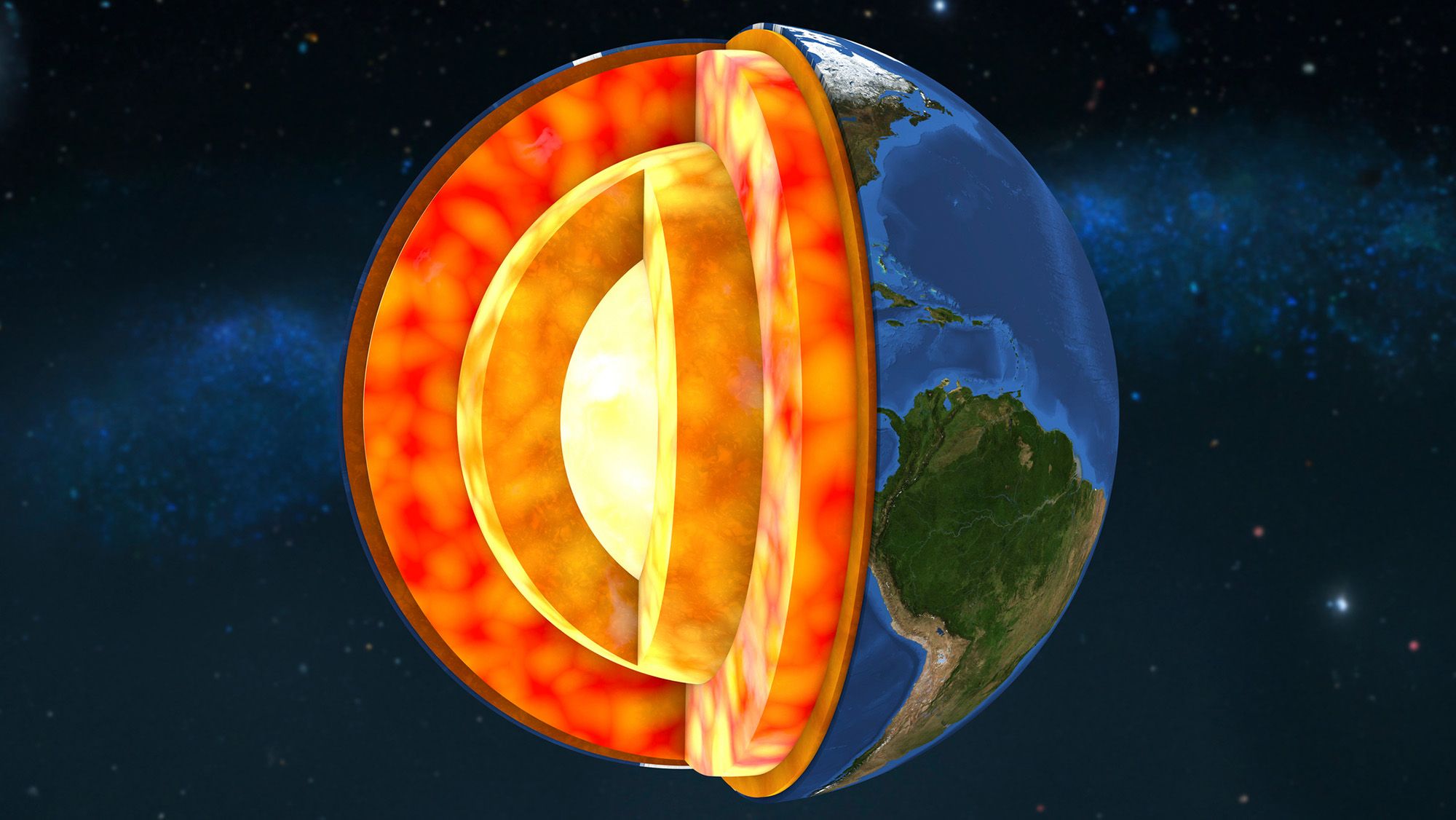
Image source: Live Science
Deep beneath our feet, locked away at the boundary between Earth's core and its mantle over one million times the pressure felt at the surface, scientists have identified a hidden reservoir that could rewrite our understanding of planetary formation. Recent research published in Nature Geoscience reveals that newly discovered iron minerals known as iron oxyhydroxides might hold primordial water left over from the very birth of our planet, offering a profound glimpse into the subterranean forces that shape continents, drive plate tectonics, and fuel volcanic hotspots across the globe.
The Discovery
The breakthrough came when an international team of researchers, including scientists from various prominent institutions, conducted extreme laboratory experiments to simulate the crushing conditions found deep inside our world. By taking mineral samples and squishing them tightly between two tiny diamond anvils while simultaneously zapping them with high-powered lasers, the research team successfully synthesised and observed stable iron oxyhydroxides. These minerals are able to withstand the brutal, high-energy impacts characteristic of early planetary accretion. Under pressures over a million times greater than normal atmospheric pressure at sea level, these dense iron-based structures demonstrated a remarkable capability to store massive amounts of water deep within the Earth's middle layer.
What Archaeologists Found
While this study crosses into the realm of deep-Earth mineralogy and geophysics rather than traditional surface excavation, the implications mirror the meticulous detective work of archaeology. Researchers found that these newly identified minerals contain as much as fifteen percent water by weight. To put this staggering concentration into perspective, mineralogist Steve Jacobsen of the University of Colorado Boulder noted that combining all the hydrogen and oxygen atoms into liquid water means a mere five-pound piece of this material would contain roughly a pint of pure liquid water. If such material existed extensively across the base of the mantle during the primordial era, even a fraction of it could have provided sufficient water to supply the formation of Earth's oceans.
Historical Background
Understanding the provenance of Earth's internal water has long challenged geologists and planetary scientists. Traditional theories generally split into two distinct schools of thought regarding how water permeated the mantle. The first theory champions subduction, suggesting that sinking tectonic plates slowly drag surface water down into the deeper layers over aeons. The second theory posits the existence of primordial water, trapped and preserved near the core-mantle boundary since the initial accretion and differentiation of the planet billions of years ago. Until now, finding physical evidence of a material robust enough to survive both primordial impacts and extreme core-boundary conditions remained elusive.
Scientific Analysis
The newly discovered iron oxyhydroxides uniquely bridge these two competing historical theories. Because they are exceptionally dense, they possess the physical capacity to sink all the way to the bottom of the mantle, supporting the subduction pathway while simultaneously establishing a viable mechanism for water to interact directly with the metallic core. Furthermore, mantle convection currents could theoretically transport these minerals upward through massive mantle plumes toward the Earth's crust. Once they ascend closer to the surface, the drop in pressure causes the minerals to melt and release their trapped water, thereby completing a vast, subterranean water cycle that may feed surface volcanic hotspots and alter the viscosity of the mantle itself.
Do you believe Earth's oceans originated primarily from primordial water trapped at the core-mantle boundary, or from relentless subduction by ancient tectonic plates? Share your thoughts in the comments section below.
Why This Discovery Matters
Water plays an indispensable role in planetary dynamics. Its presence within molten rock lowers viscosity, making the mantle stretchier and more amenable to convection. Without this crucial softening agent, the mantle would remain too stiff to facilitate plate tectonics or drag continental crust across the globe. Additionally, these minerals offer a compelling explanation for the mysterious, ultra-low seismic velocity patches detected by seismologists sitting directly on top of the core-mantle boundary. These dense, anomalous regions may well be vast reservoirs of iron oxyhydroxides acting as silent archives of Earth's earliest history.
What's Next?
Although the published study does not definitively prove that these specific minerals are currently taxiing water through active mantle plumes, confirming their existence opens entirely new pathways for future investigation. Researchers plan to refine their high-pressure diamond anvil cell experiments to map out exact transport rates and thermal stability thresholds. Additionally, planetary scientists intend to apply these mineral models to exoplanets and other rocky worlds, evaluating whether similar deep-water reservoirs might exist on distant planets possessing molten mantles.
Conclusion
The identification of stable iron oxyhydroxides at extreme pressures marks a monumental leap in geosciences. By successfully demonstrating that dense subterranean minerals can retain vast quantities of water under core-mantle boundary conditions, researchers have illuminated a plausible missing link in planetary evolution. As investigative techniques advance, our understanding of how Earth stores, circulates, and ultimately protects its most vital compound will continue to deepen.
Frequently Asked Questions
What are iron oxyhydroxides?
Iron oxyhydroxides are newly studied iron minerals discovered through high-pressure laboratory experiments that remain stable under the extreme conditions found at the boundary between Earth's core and mantle.
How much water can these minerals store?
These iron minerals can contain up to fifteen percent water by weight, meaning a small five-pound sample could theoretically yield approximately a pint of liquid water.
How does this research impact theories about Earth's oceans?
The findings support the theory of primordial water, suggesting that material trapped near the base of the mantle during Earth's formation could have significantly contributed to the creation of surface oceans.
