
Image source: Live Science
In 1833, stone quarry workers unearthed an ancient burial mound at Bryn yr Ellyllon, known as Goblins' Hill, near Mold in Wales. Within a stone-lined grave lay a crushed, hammered gold cape dating to between 1900 and 1600 B.C., alongside a fragmented human skeleton.
Now preserved and exhibited at the British Museum, the Mold gold cape represents one of the finest examples of prehistoric goldwork ever recovered. Its intricate manufacture, unique form, and mysterious context provide a rare view into the craftsmanship and ceremonial culture of Britain during the Early Bronze Age.
The Discovery
The discovery of the artefact occurred entirely by accident in the early nineteenth century. While clearing land at Bryn yr Ellyllon, Welsh quarry labourers broke into a central burial mound. Beneath the stone mantle, they uncovered an intact, stone-lined grave containing human skeletal remains that had fragmented over millennia.
Lying directly with the remains was a large, flattened sheet of gold that had been crushed by the weight of earth and stones. The quarry workers recovered the damaged goldwork, but the accompanying skeletal remains were not preserved. The failure to salvage the human bones during the nineteenth-century quarrying operation permanently deprived modern researchers of direct skeletal evidence, creating lasting questions regarding the identity of the person buried beneath the mound.
What Archaeologists Found
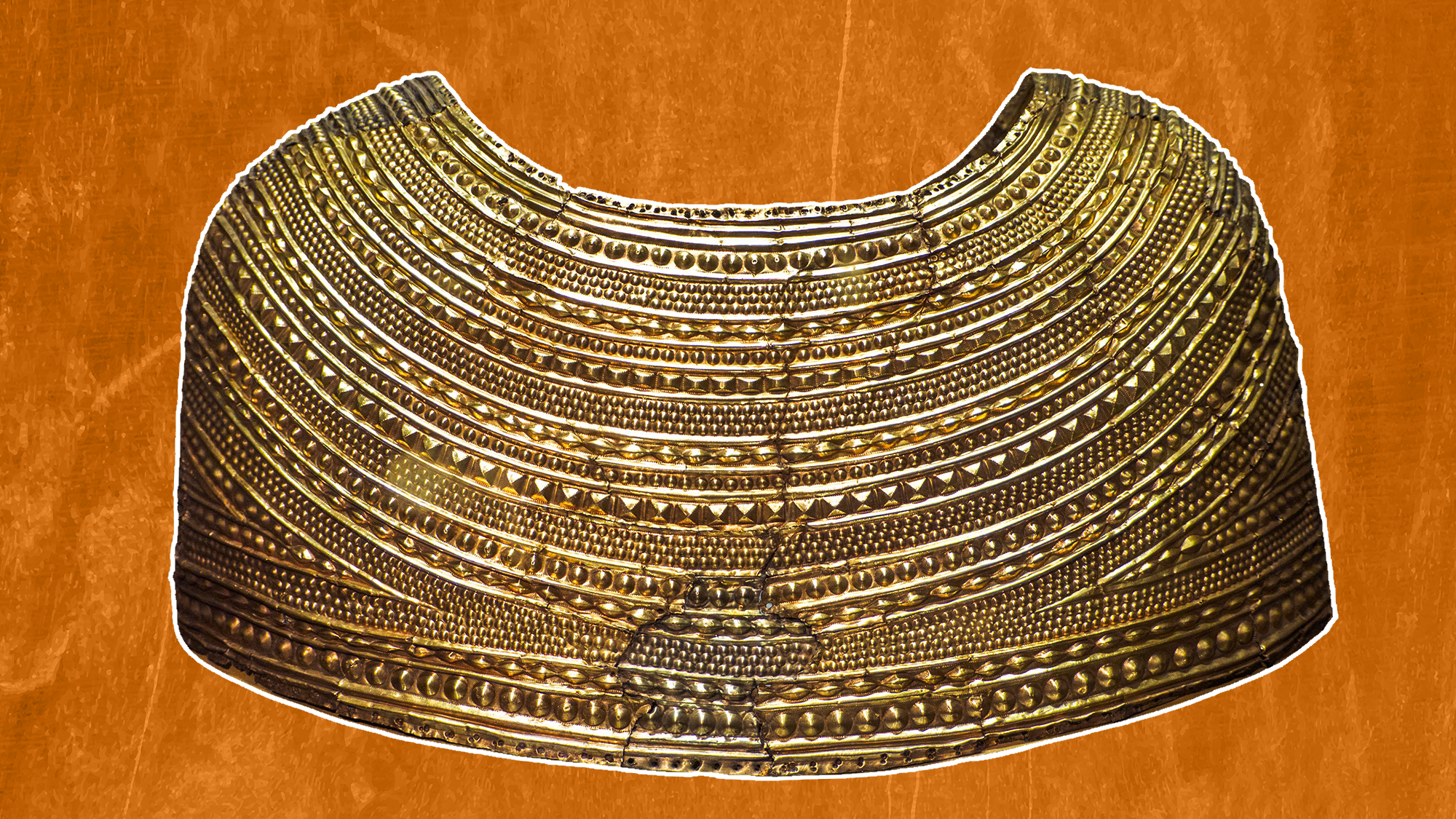
Following its acquisition by the British Museum, conservators pieced together the crushed fragments to reveal a singular, shoulder-spanning garment. The finished cape measures roughly 23.5 centimetres (9.3 inches) in height and 46.5 centimetres (18.3 inches) in width, weighing approximately 560 grams (1.2 pounds).
Analysis revealed that ancient metalworkers manufactured the entire cape from a single ingot of gold, estimated to have been roughly the size of a ping-pong ball. The artisan beat this gold lump into an exceptionally thin, uniform sheet before shaping it into a curved garment designed to sit over the chest and shoulders.
The artefact features complex decorative bands:
- Repoussé ornamentation hammered from behind to mimic concentric strings of beads and layered necklaces.
- Perforations along the upper neck opening, indicating where a protective lining of leather or another perishable organic material was once stitched.
- Several hundred amber beads discovered in the grave alongside the gold sheet, which originally accented the gilded ensemble.
Historical Background
The manufacture of the Mold gold cape dates to Britain's Early Bronze Age, an era spanning roughly 2500 to 1200 B.C. The specific creation of the cape is placed between circa 1900 and 1600 B.C.
This era marked a profound technological and cultural transition across the British Isles. Communities shifted away from the exclusive use of worked flint tools and entered a metalworking revolution. Specialized artisans mastered high-heat metallurgy, producing weapons, ornaments, and prestige items from gold, copper, and bronze. The mastery needed to expand a small gold pellet into a structural, decorated garment showcases the sophisticated technological heights achieved by Early Bronze Age metalsmiths.
Scientific Analysis
When antiquarians and early researchers first examined the find, they assumed that an object of such spectacular opulence must have belonged to a powerful male authority figure, such as a local chieftain, warrior, or influential religious leader. However, modern scientific reassembly challenged this nineteenth-century assumption.
Once the broken pieces were fully reconstructed, the internal dimensions showed that the cape was surprisingly small. The tight proportions mean that an adult male warrior could not have worn it. Instead, the physical measurements indicate the cape was designed for an individual of slight build, most likely a woman or a child. Because nineteenth-century quarry workers failed to collect the fragmented skeleton, modern osteological and chemical testing cannot confirm the biological sex or age of the deceased.
Biomechanically, the rigid gold structure severely limits movement. When fitted over the shoulders, the cape immobilizes the wearer's upper arms, preventing physical labour or combat. Researchers conclude that it was never designed as protective armour or everyday apparel. Rather, it functioned as an elite ceremonial garment, likely donned during high-status religious rites to project sacred authority.
Why This Discovery Matters
The Mold gold cape holds an exceptional place in European archaeology. Its decorative motifs and sheet-gold execution demonstrate unprecedented technical sophistication for Early Bronze Age Britain.
Benjamin Roberts, former curator for the European Bronze Age collections at the British Museum, emphasized the artefact's solitary status in prehistoric archaeology:
The cape is unique — there is really nothing to compare it to in the whole of Europe. This makes it more difficult to understand why it was made and what significance it had.
The total absence of comparable metal garments across the continent leaves specialists without contemporary stylistic parallels, underscoring the cape's status as a distinct regional masterpiece.
What's Next?
Because the original osteological material is lost, modern research relies on advanced non-destructive imaging and metallurgical study of the gold sheet and amber beads. Curators at the British Museum continue to examine the manufacturing methods and tool marks left by the Bronze Age smiths.
Significant questions remain unresolved regarding the burial itself. Researchers still seek to determine why an object requiring immense labour and material wealth was taken out of circulation and sealed within a stone cist at Goblins' Hill, and what specific religious obligations dictated its final deposition.
Given the restrictive design of the garment, what do you think was the primary role of the person buried with the Mold gold cape—an elite ritual specialist, a political figurehead, or a symbol of dynastic power? Share your perspective in the comments below.
Frequently Asked Questions
Where was the Mold gold cape found?
Quarry workers discovered the cape in 1833 within a stone-lined grave at Bryn yr Ellyllon, also known as Goblins' Hill, near the town of Mold in Wales. It was buried in a prehistoric burial mound alongside a fragmented human skeleton.
Who wore the Mold gold cape?
While nineteenth-century experts initially assumed it belonged to a male chieftain or warrior, the reconstructed dimensions show it was made for someone of small stature, such as a woman or child. Because the human skeleton was not preserved during the 1833 quarrying, the wearer's biological sex remains unconfirmed.
What is the Mold gold cape made of?
The artefact was hammered from a single ingot of gold roughly the size of a ping-pong ball into a very thin, decorated sheet weighing approximately 560 grams. Perforations around the neck suggest it originally possessed an inner lining of leather or perishable material, and it was buried alongside several hundred amber beads.
