
Image source: Ancient Origins
Buried two and a half metres beneath a routine hotel elevator shaft installation in Barcelona's historic Gothic Quarter, a monumental discovery has upended decades of scholarly consensus. Excavations at the Gran Hotel Barcino have revealed an intact stone pavement belonging to the ancient Roman colony of Barcino, forcing historians to completely redraw the civic map of the settlement founded by Emperor Augustus between 15 and 10 BC.
The Discovery
The archaeological intervention commenced in June 2023 when workers on Carrer d'Hèrcules began digging a small six-square-metre hole for a new lift shaft inside the 14th-to-15th-century Casa Requesens. As is standard practice for intrusive groundworks, a preventive archaeological inspection was ordered. At a depth of approximately 2.5 metres, however, inspectors struck massive, perfectly aligned stone slabs dating back to antiquity. Recognizing the profound significance of the find, the hotel's owners, the Gargallo Hotels chain, took the commendable initiative to finance a two-year, 80-square-metre archaeological excavation directed by Jordi Amorós of AGER Arqueologia and supervised by the Barcelona Archaeology Service (ICUB) and the Generalitat de Catalunya's Territorial Cultural Services.
What Archaeologists Found
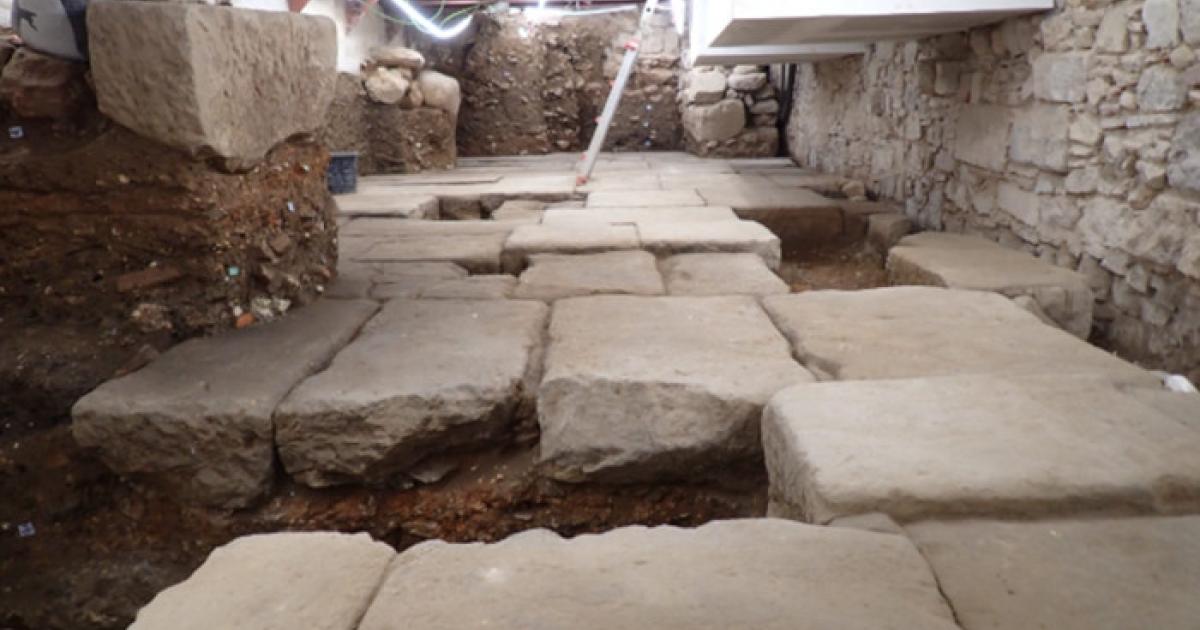
The centerpiece of the excavation is a pavement covering roughly 42 square metres, constructed from massive Montjuïc stone slabs. Individual blocks measure up to 149 centimetres long and 118 centimetres wide, with thickness varying deliberately between 18 and 35 centimetres to compensate for the uneven natural bedrock. Adjacent to this monumental paving, archaeologists documented a substantial Roman concrete structure alongside two square wells exceeding 2.6 metres in depth. These wells are connected by an intricate siphon hydraulic mechanism, indicating the presence of an ornamental water feature or public fountain. Furthermore, the site yielded over 150 fragments of imported Mediterranean marble originating from Carrara, mainland Greece, the Aegean islands, Anatolia, and Egypt, demonstrating that the forum was once lavishly decorated with costly architectural cladding.
Historical Background
Founded as Iulia Augusta Faventia Paterna Barcino under Augustus, the colony's layout had long been a subject of intense academic study. For decades, historians believed that Barcino's forum ran north-south along the cardo maximus, aligning with the modern Palau de la Generalitat and Plaça Sant Jaume. The new discovery shatters this hypothesis. The Montjuïc slabs run parallel to the decumanus maximus, oriented northwest to southeast. According to Xavier Maese of the Barcelona Archaeology Service, this reveals that the forum actually turned 90 degrees, running on an east-west axis from the sea toward the mountains. Later occupational layers at the site document the gradual decline of the forum, with ceramic evidence from the wells pointing to abandonment by the mid-6th century AD, while material spoliation at the northeastern edge indicates the loss of civic function at the beginning of the 5th century AD during the arrival of the Visigoths.
Scientific Analysis
Advanced photogrammetry conducted by Global Geomatics and rigorous stratigraphical analysis captured the complete architectural sequence of the site. The engineering behind the Montjuïc stone slabs showcases sophisticated Roman geotechnics, utilizing variable thicknesses to achieve a completely level surface over undulating bedrock. The hydraulic siphon system reflects deep mastery of fluid dynamics within standard Roman civic planning. Moreover, the imported marble fragments underwent comparative petrographic analysis, confirming elite procurement networks spanning the entire empire. Ceramic typologies retrieved from the wells and the later medieval grain storage silo provided absolute chronological markers, neatly compressing 1,500 years of continuous human occupation into a single stratigraphical profile.
Why This Discovery Matters
This finding is a monumental turning point for our understanding of Roman Hispania. By forcing a 90-degree reorientation of the city's urban grid, it challenges every published map of ancient Barcino produced over the last century. It also raises a fascinating question for our readers: How many other capitals of the ancient world are hiding entirely misaligned civic centers directly beneath our modern feet? Share your thoughts in the comments section below.
What's Next?
Following the conclusion of fieldwork in July 2025, the discovered remains have been structurally stabilized through the installation of 70 micropiles supporting the Gothic building above. The hotel has successfully integrated the archaeological zone into a dedicated underground museum space within the Casa Requesens. While primary access will be granted to hotel guests, the Barcelona City Council has arranged periodic guided public tours, allowing citizens and researchers alike to examine the founding floor of Barcino firsthand.
Conclusion
The revelation beneath the Gran Hotel Barcino serves as a striking reminder that urban archaeology is a dynamic, ever-changing discipline. Through exemplary collaboration between private enterprise and public heritage authorities, a routine infrastructure upgrade has transformed into a cornerstone of Catalan archaeology. Barcino's true heart has finally been located, breathing new life into the classical heritage of modern Barcelona.
Frequently Asked Questions
When was the Roman forum discovered beneath the Barcelona hotel?
The discovery was initially made in June 2023 during elevator shaft installations and was officially announced by the Barcelona Archaeology Service in late February 2026.
Why does this discovery force a rewrite of Barcelona's history?
The newly found paving stones demonstrate that the ancient forum was oriented along the east-west axis rather than the north-south axis, forcing a 90-degree correction to the previously accepted map of Barcino.
How was the excavation funded and preserved?
The entire two-year excavation was financed privately by the Gargallo Hotels chain, and the ancient remains have been permanently stabilized and integrated into a subterranean visitor space.
