
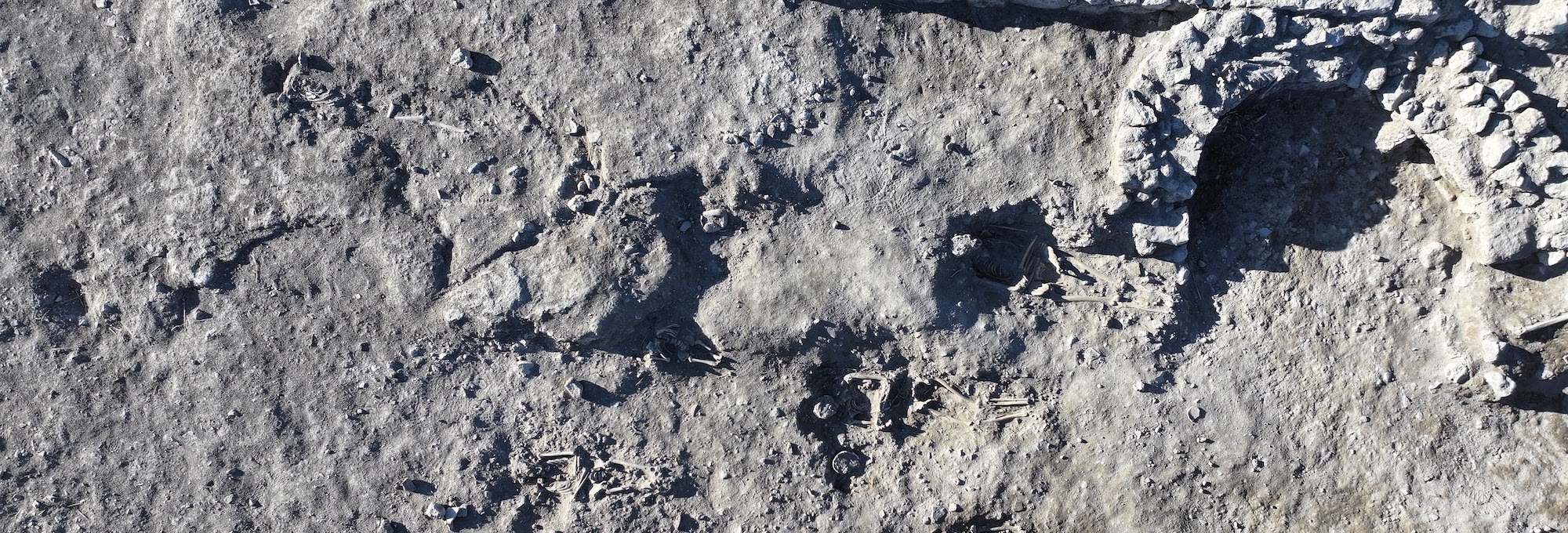
Image source: Archaeology Magazine
Along the sun-drenched Adriatic coastline of Italy, excavation work at the ancient port city of Sipontum has brought to light a poignant medieval burial containing the skeletal remains of an adult woman cradling a young child. Led by researchers from the University of Bari Aldo Moro, the archaeological team uncovered the double interment within a historic cemetery context, offering a rare, physical glimpse into intimate medieval familial bonds, community healthcare practices, and regional burial customs during a period of significant Mediterranean transformation.
The Discovery
The striking sepulchre was identified during routine archaeological investigations within the medieval zone of the coastal site of Sipontum, situated in the Apulia region of southern Italy. According to project lead Giuliano Volpe of the University of Bari Aldo Moro, the positioning of the skeletal remains immediately drew the attention of field specialists. The adult woman, whose age at death is estimated to be between thirty and forty years old, was interred with the child—determined to be between five and seven years of age—positioned directly in her arms. The physical intimacy of the arrangement suggests an intentional, tender placement rather than a simultaneous mass casualty burial, pointing directly to a deeply personal relationship between the two individuals at the time of their demise.
What Archaeologists Found
Excavation of the burial revealed stark characteristics typical of modest medieval mortuary practices within the broader port community. The remains were deposited in a simple fashion, largely devoid of elaborate grave goods, precious metals, or complex costume elements that might indicate high social status or distinct wealth. Apart from a single fibula and faint traces of a corroded metal bracelet, the deceased were unaccompanied by personal adornments. Field observations indicate that the bodies were likely wrapped tightly in organic shrouds before being placed into the earth. The overall austerity of the grave reflects a utilitarian approach to communal burial, contrasting sharply with the opulent monumental tombs often highlighted in medieval ecclesiastical archaeology.
Historical Background
Contextualizing the cemetery requires looking closely at the stratigraphy directly above the burial layers. Excavators recovered distinctive fragments of painted plaster and medieval ceramics from the soil matrices overlying the graves, enabling researchers to date the cemetery broadly to the twelfth or thirteenth century. During this medieval epoch, Sipontum functioned as an active Adriatic port city characterised by vibrant maritime trade, religious institutions, and urban infrastructure. Archaeologists suggest that the cemetery was situated in close geographic proximity to a major community institution, such as a local church, a monastery, or a medieval hospital, which would have managed the healthcare needs, spiritual welfare, and final rites of the port's diverse populace.
Scientific Analysis
To move beyond basic archaeological observations, the research team has outlined a rigorous schedule of scientific testing. Because visual examination can only yield preliminary biological profiles, specialists plan to conduct targeted DNA analysis to clarify the exact kinship ties between the adult woman and the child. While physical proximity strongly implies a maternal or close familial connection, genetic profiling will confirm whether they shared biological lineage or if the child was adopted or unrelated. Additionally, accelerator mass spectrometry carbon dating is scheduled for the skeletal remains to narrow down the chronological window of the interments, supplementing the relative dating previously established by the surrounding ceramic typology and architectural plaster fragments.
Why This Discovery Matters
Finds of this nature bridge the vast gap between macro-level historical trends and the intimate realities of individual human lives in medieval Italy. While written archives often record political maneuvers, crusades, and ecclesiastical decrees, they frequently overlook the emotional landscapes, family structures, and health vulnerabilities of ordinary women and children living in coastal port settlements. By analyzing the biological stress markers, dental health, and isotopic signatures of these two individuals, bioarchaeologists can reconstruct broader patterns of medieval morbidity, child mortality rates, and epidemiological conditions in a bustling maritime hub. This discovery invites us to pause and reflect on the universal human dimensions of grief, care, and mortality preserved silently in the archaeological record for nearly eight centuries. How do you think modern archaeological science should balance the ethical considerations of excavating human remains with the historical knowledge gained from such intimate burials?
What's Next?
As field operations at Sipontum conclude their current phase, the focus shifts entirely from the trenches to specialized laboratories. Anthropologists and geneticists will extract microscopic samples from the bones to begin the intricate process of DNA sequencing and stable isotope analysis. These forthcoming laboratory results will not only verify the biological relationship between the woman and child but also provide vital clues regarding their geographic origins, diet, and potential exposure to regional pathogens during the high medieval period. The final peer-reviewed publication of these findings will integrate the osteological data with the wider historical topography of the medieval Adriatic port.
The excavation at Sipontum underscores the enduring capacity of Italian soil to preserve the quiet, untold narratives of the medieval past. Through meticulous excavation, advanced osteoarchaeology, and genetic inquiry, researchers continue to give voice to populations that history nearly forgot, ensuring that the physical legacy of these coastal communities remains anchored in scientific understanding.
Frequently Asked Questions
Where was the medieval grave discovered?
The grave was unearthed at the coastal archaeological site of Sipontum, located along the Adriatic Sea in the Apulia region of southern Italy. The site features an extensive medieval cemetery associated with the ancient port city.
What were the estimated ages of the individuals?
Osteological assessments indicate that the adult woman was between thirty and forty years old at the time of her death. The child buried in her arms is estimated to have been between five and seven years of age.
Are there any grave goods associated with the burial?
The burials were notably simple and lacked elaborate grave goods or personal ornamentation. Archaeologists recovered only a single fibula and faint traces of a metallic bracelet, suggesting the bodies were likely wrapped in shrouds.
How are researchers determining their relationship?
While the physical arrangement of the child resting in the woman's arms strongly suggests a close relationship, researchers are conducting DNA analysis to confirm the precise biological kinship between the two individuals.
