
AnotherShadows Digital Archaeology Magazine
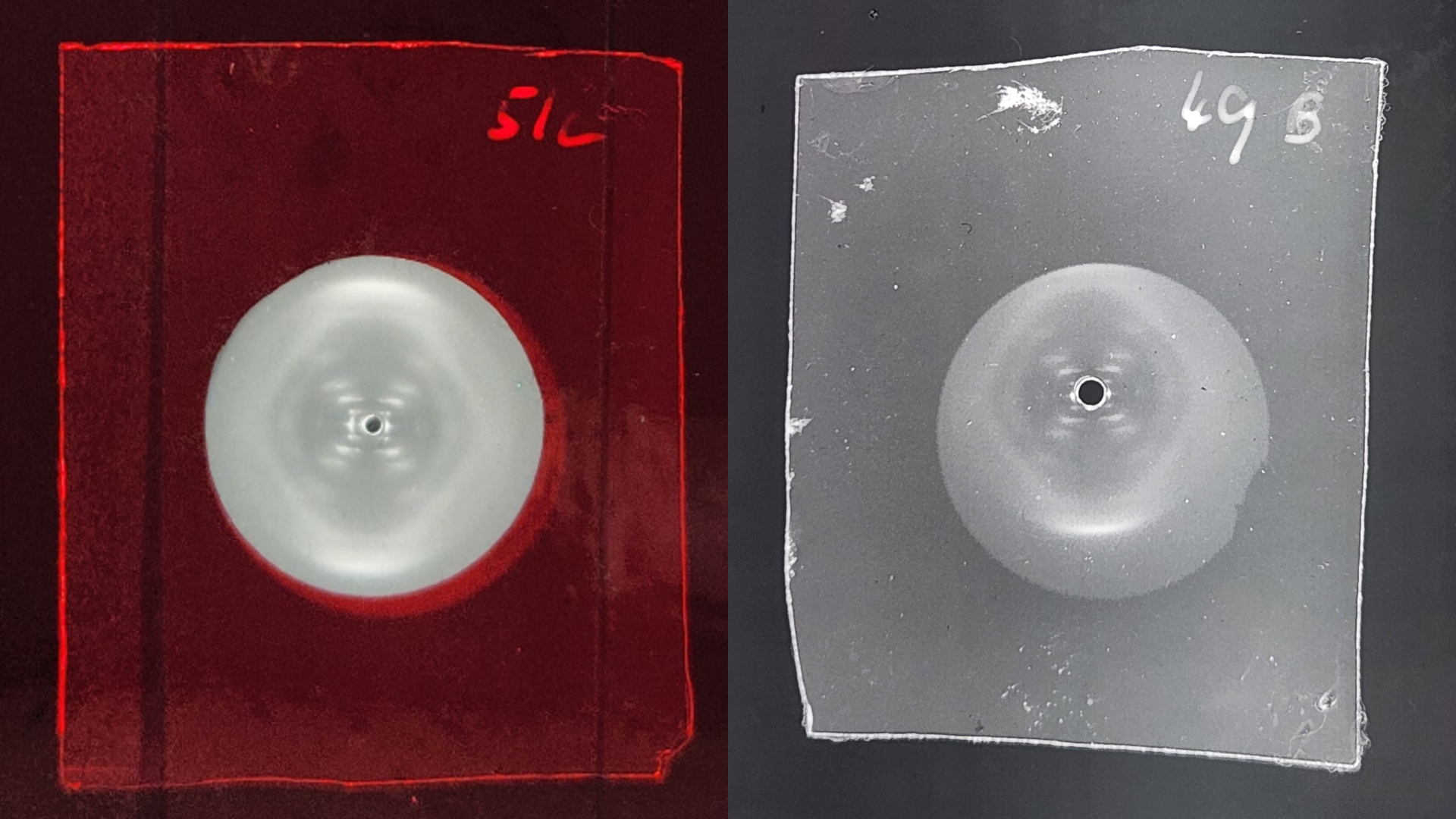
Image source: Live Science
A recent examination of historical archival material indicates that pioneering scientist Rosalind Franklin recognized the helical structure of DNA before James Watson and Francis Crick formulated their famous model. The research, published in the Journal of the History of Biology by historians and scientists, reassesses the creation and purpose of Franklin's iconic Photograph 51, offering a fresh perspective on her contributions to molecular biology.
For decades, popular narratives stemming from accounts like Watson's 1968 autobiography portrayed Franklin as a laboratory technician who captured crucial data without fully understanding its significance. However, this new archival work challenges those long-held assumptions by examining the sequence and intent behind her experimental imagery at King’s College London.
The Discovery
The new research highlights the relationship between two specific X-ray crystallography images captured by Franklin: Photograph 49 and Photograph 51. Newly acquired archival materials from the Science History Institute in Philadelphia, combined with documents from King’s College London, reveal that Photograph 51 was intentionally exposed to create a refined showpiece rather than an accidental capture. Study co-author Alistair Sponsel, a historian of science at the Science History Institute, noted that this deliberate action signifies Franklin's awareness of the importance of her work.
Franklin began Photograph 51 on the exact same day she observed the results of Photograph 49. By pursuing a sharper exposure of the same sample, she demonstrated a clear understanding that she held crucial structural data regarding the DNA molecule. Molecular biophysicist Brian Sutton of King's College London collaborated with Sponsel on the research, detailing how these archival documents correct historical misunderstandings regarding Franklin's data interpretation capabilities.
What Archaeologists Found
While the subject matter pertains to molecular biology rather than excavation, historians examining these archives uncovered detailed laboratory journals that clarify Franklin's analytical process. The records demonstrate that Franklin noted potential helical shapes and complex structural properties in her notes for Photograph 49. Rather than missing the significance of the data, she categorized her images functionally: Photograph 49 served as the initial experimental capture revealing novel data, while Photograph 51 acted as the definitive visual presentation.
These documents counter the assertion that Franklin lacked the interpretative skill to grasp her own findings. Instead, her journals indicate a methodical approach to documenting different physical states of the DNA molecule before rushing to premature conclusions.
Historical Background
In the early 1950s, the race to determine the physical structure of DNA involved multiple research groups, notably at King's College London and the Cavendish Laboratory in Cambridge. Franklin and her graduate student Raymond Gosling were tasked with applying X-ray crystallography to analyse DNA fibres, which were known to exist in two distinct structural forms, designated as A and B. Structure A represented a dehydrated laboratory form, while Structure B corresponded to the naturally occurring double helix.
Franklin prioritised the data-rich Structure A for comprehensive characterisation before fully focusing on Structure B. During this meticulous process, Maurice Wilkins shared Franklin's unpublished images of Structure B with Watson and Crick. Armed with these visual clues, Watson and Crick constructed their definitive model and published their findings, securing a 1962 Nobel Prize alongside Wilkins, while Franklin passed away from ovarian cancer in 1958.
Scientific Analysis
The methodological approach taken by Franklin involved balancing rigorous data collection with careful comparative analysis between different structural states. Her February 1952 research report outlined a structured plan to investigate both forms methodically. The historical misinterpretation largely arose because her published notes on Photograph 51 were sparse compared to the rapid publishing pace of her Cambridge competitors.
By treating the two photographs as distinct types of scientific communication, Franklin exhibited a rigorous scientific standard. Her notebooks confirm that she identified the foundational symmetry required for a helical architecture before her male colleagues integrated those visual data points into their physical model.
Why This Discovery Matters
This archival study rectifies historical omissions regarding female scientists in prehistory and the modern era alike, demonstrating how institutional records can correct entrenched narratives. By restoring the proper chronology of scientific discovery, researchers ensure that historical credit is assigned accurately. Furthermore, the findings highlight the importance of primary source documentation in evaluating the contributions of scientists who worked in environments where their authority was frequently marginalized.
What are your thoughts on how historical archives can reshape our understanding of major scientific milestones? Share your perspective in the comments below.
What's Next?
Researchers plan to continue cataloguing and analysing the newly acquired collections at the Science History Institute and King’s College London. These ongoing archival efforts aim to recover additional correspondence and laboratory notes from early molecular biologists, providing a more comprehensive view of the collaborative and competitive dynamics that defined mid-century scientific research.
As historians examine these primary sources, the broader scientific community gains a richer appreciation of the rigorous methodologies employed by researchers whose contributions were historically downplayed or overlooked.
Frequently Asked Questions
What did the new archival study reveal about Rosalind Franklin?
The study reveals that Franklin understood DNA's helical structure and intentionally captured Photograph 51 as a refined showpiece rather than an accidental shot. Her laboratory notes confirm she recognized the critical structural data from the outset.
Why was Rosalind Franklin excluded from the 1962 Nobel Prize?
Franklin passed away from ovarian cancer in 1958, making her ineligible for the Nobel Prize since the award is not granted posthumously. Additionally, her findings were shared with competing researchers without her initial knowledge.
How do Photographs 49 and 51 differ in purpose?
Franklin viewed Photograph 49 as an experimental image that revealed exciting new structural data about the DNA molecule. In contrast, she used Photograph 51 to convey those exact findings with maximum clarity and sharpness.
